How Do Scientists Distinguish Humpback Whale Songs From Other Underwater Sounds?
The ocean is filled with sounds that people rarely hear directly. Marine animals produce calls, waves create underwater noise, and vessels generate sounds that can travel through the water. When scientists record these sounds, they face an important challenge: determining which sounds are likely to come from humpback whales and which have another source.
This task is essential for understanding whale communication. Before researchers can study a song's structure, compare recordings, or investigate changes in vocal behavior, they need to establish whether the recording contains a genuine whale vocalization.
Scientists approach this problem by examining acoustic patterns, listening to recordings, studying spectrograms, comparing sounds with known examples, and evaluating the recording context. Automated detection tools can help, but their results also require careful checking.
For visitors interested in Samaná whale watching in the Dominican Republic, this process reveals an often-overlooked part of whale research: identifying an underwater sound can be a scientific investigation in its own right.
Why Is Identifying Whale Songs Underwater Difficult?
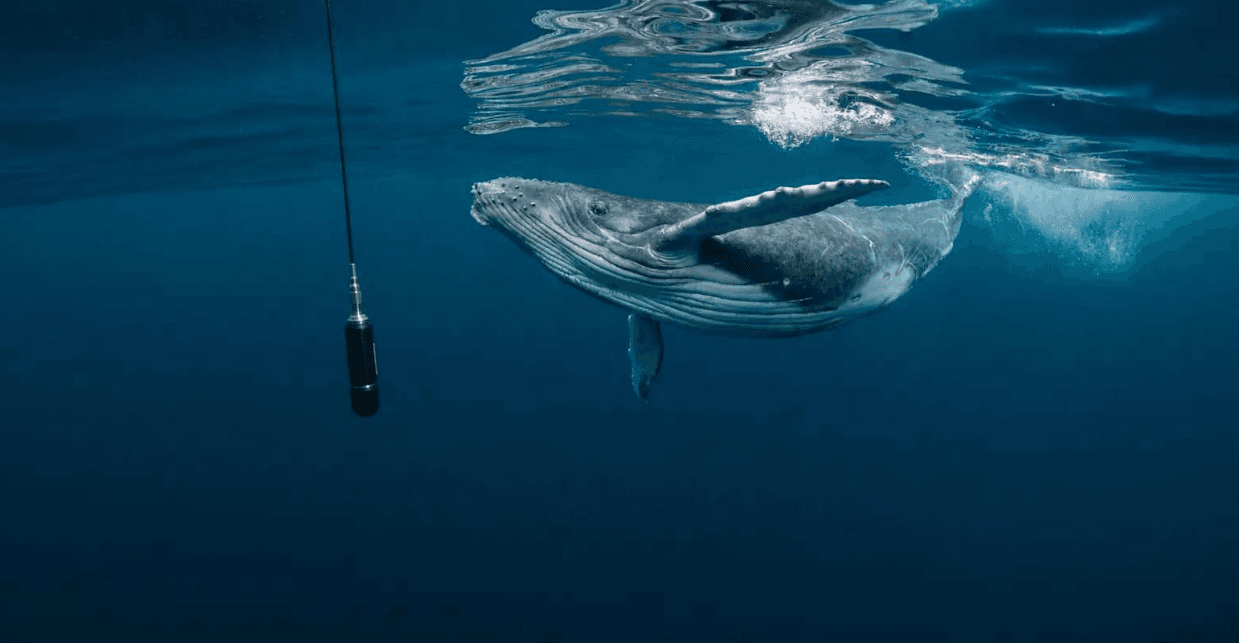
Underwater recordings rarely contain only one sound source. A hydrophone, which is a microphone designed for underwater use, may capture several sounds at the same time.
A recording could contain a whale vocalization alongside vessel noise, water movement, other marine animal sounds, or sounds from distant sources. Some of these sounds may overlap in frequency or timing, making identification difficult.
The challenge becomes greater when a recording is short, noisy, or incomplete. A sound that is easy to recognize in a clean recording may be much harder to identify when it is mixed with other acoustic activity.
Scientists must also distinguish between a sound's apparent characteristics and its actual source. Two different sources can produce acoustically similar signals, while sounds from the same species may vary considerably.
Consequently, researchers do not rely on one characteristic alone. They evaluate several features together and consider how confidently the available evidence supports a particular identification.
1. Listening for Recognizable Vocal Patterns
One of the first steps is listening to the recording.
Experienced researchers may recognize acoustic patterns associated with humpback whale songs, including sequences of tonal sounds, changing pitches, moans, and other recurring elements.
A song may contain recognizable phrases that repeat or follow an organized sequence. These patterns can provide useful clues that distinguish a possible song from irregular background noise.
However, not every humpback whale vocalization is a song. Whales also produce other vocal sounds, and some recordings may contain sounds that are difficult to classify confidently.
Listening therefore provides an initial assessment rather than an infallible identification method.
Researchers may listen to a recording several times, use headphones or suitable audio equipment, and examine different sections separately. They may also compare the recording with reference examples whose sources have been established more reliably.
The goal is to identify meaningful acoustic features without assuming that every unusual underwater sound comes from a whale.
2. Examining Spectrograms for Acoustic Clues
A spectrogram is one of the most useful tools for investigating underwater sounds.
It displays how the frequency content of a recording changes over time. Time usually appears on the horizontal axis, frequency on the vertical axis, and sound intensity is represented through visual variations.
Different sounds can produce different spectrogram patterns.
For example, a tonal vocalization may appear as a narrow line that rises or falls in frequency. A broadband sound may occupy a wider range of frequencies. Repeated sounds may create recognizable patterns across the recording.
These visual features help researchers examine sounds that may be difficult to distinguish by listening alone.
A spectrogram can also reveal whether multiple sounds overlap. One signal might continue while another begins, making it clear that the recording contains more than one acoustic component.
Nevertheless, a spectrogram does not automatically reveal the source of every sound. Different animals and mechanical sources can produce overlapping acoustic patterns. Researchers need to interpret the visual evidence alongside other information.
The settings used to generate a spectrogram also matter. Frequency range, time resolution, and other processing choices can affect how a sound appears. Consistent settings are especially important when comparing recordings.
3. Distinguishing Whale Songs From Vessel Noise
Vessel noise is an important consideration in marine acoustic research, including studies conducted in areas where boats and wildlife share the same waters.
Ships and smaller boats can generate sound through engines, propellers, and other mechanical processes. The resulting recordings may contain continuous noise, changing tonal components, or broadband sound.
Some vessel sounds may overlap with the frequency ranges used by marine animals. As a result, researchers cannot identify a whale vocalization simply because it appears in a particular frequency band.
Instead, they examine the overall acoustic pattern.
A candidate whale song may contain organized tonal elements and recurring phrases. Vessel noise may show different characteristics, such as sustained mechanical components or changes associated with engine operation. However, these are general clues rather than absolute rules.
A boat recording can contain both vessel noise and whale vocalizations at the same time. Scientists must therefore avoid treating an entire recording as either purely biological or purely mechanical when the evidence indicates a mixture.
Where appropriate, researchers can compare acoustic observations with vessel-location information, known operating periods, or other contextual records.
This helps them investigate whether a sound is consistent with a mechanical source or whether another explanation is more plausible.
4. Separating Whale Vocalizations From Other Animal Sounds
Humpback whales are not the only animals producing sounds underwater. Depending on the location, recordings may contain vocalizations from other marine mammals and sounds from other aquatic animals.
Some of these sounds may be easy to distinguish, while others may share similar acoustic characteristics.
Scientists investigate several features when attempting to identify the source:
- The frequency range of the sound.
- The duration and shape of individual elements.
- The pattern of repeated sounds.
- The organization of sounds into sequences.
- The presence of acoustic features associated with known reference recordings.
A sound's timing and context can also help. For example, a sequence of recognizable humpback whale song elements may provide stronger evidence for a song identification than a single isolated sound.
Even so, researchers should not assign a species label when the acoustic evidence is insufficient.
Depending on the quality of the recording, a sound may be classified as a probable whale vocalization, a possible vocalization, or an unidentified acoustic event. The terminology used varies by research project, but the principle is the same: the confidence of the identification should match the available evidence.
5. Looking for Repetition and Sequence Structure
A single sound may not provide enough information to determine its source. A longer sequence can offer more clues.
Humpback whale songs often include repeated elements and organized phrases. When researchers detect a candidate sound, they can examine the surrounding recording to see whether related sounds occur before or after it.
For example, an isolated tonal sound might have several possible explanations. If it appears within a longer sequence containing recognizable, repeated song patterns, the evidence for a whale-song interpretation may become stronger.
Researchers may analyze:
- The spacing between sounds.
- Whether similar elements recur.
- Whether sound shapes remain consistent.
- Whether the recording contains a recognizable sequence.
- Whether the sequence resembles independently verified examples.
This approach uses the surrounding acoustic structure rather than judging a sound in isolation.
However, sequence structure is not definitive proof. A short or incomplete recording may omit the most informative parts of a song, and unrelated sounds may occur near genuine whale vocalizations.
Scientists must consider the whole recording and avoid assuming that neighboring sounds necessarily come from the same source.
6. Using Reference Recordings
Reference recordings can help scientists determine whether an unfamiliar sound resembles a known vocalization.
Researchers may compare a candidate sound with recordings that have been identified using strong supporting evidence. They can examine its frequency characteristics, duration, contour, and sequence structure.
Such comparisons are useful because they provide a documented basis for evaluating similarities.
However, the quality of a reference library affects how well it supports identification. A library containing only a limited range of sounds may not represent all the acoustic variation found in nature.
Recording conditions can also differ. A vocalization captured clearly by one hydrophone may appear different when recorded from farther away or mixed with substantial background noise.
Scientists should therefore use suitable reference examples and account for differences in recording conditions. A close acoustic match may support an identification, but it does not always prove the sound's source.
7. How Automated Detection Helps Researchers
Modern acoustic research can involve large quantities of underwater recordings. Reviewing every second manually may be impractical, especially when researchers need to locate relatively short vocalizations within long periods of background sound.
Automated detection tools can help by scanning recordings for patterns that resemble known whale sounds.
Some systems use predefined acoustic features, while others use machine-learning methods trained on labeled recordings. Depending on the system, they may identify candidate vocalizations, mark relevant sections, or classify sounds into broad categories.
This can save time by directing researchers toward recordings that deserve closer examination.
However, automated systems can make mistakes.
A system may classify a mechanical sound as a whale vocalization, miss a genuine vocalization hidden by noise, or perform poorly on recordings that differ from its training data.
For that reason, scientists evaluate detection performance using suitable labeled examples and test how well the system works under different recording conditions.
Automated detection is best understood as a tool that supports acoustic research, not as an infallible replacement for scientific verification.
8. Why False Detections Matter
A false detection occurs when a system or observer identifies a whale vocalization where the evidence does not support that conclusion.
False detections can affect research findings. If mechanical noise is repeatedly classified as whale song, scientists may overestimate how often vocalizations occur or draw inaccurate conclusions about when whales are acoustically active.
Missed detections create the opposite problem. Genuine whale vocalizations may go unnoticed, particularly when they are faint or overlap with background noise.
Researchers therefore evaluate both types of error.
They may review a sample of detections manually, compare automated results with carefully labeled recordings, and document uncertainty in their analysis.
The balance between false detections and missed sounds depends partly on the purpose of the study. A system designed to find as many possible vocalizations as possible may use different decision thresholds from a system designed to produce a highly reliable collection of confirmed examples.
Understanding these trade-offs helps scientists decide how to use the resulting data.
9. Can Scientists Identify the Individual Whale From Its Song?
Identifying a vocalization is not the same as identifying the individual that produced it.
A recording may contain a recognizable humpback whale song, yet provide insufficient evidence to determine which whale was singing.
Even when scientists observe a whale near the recording equipment, they must consider whether the recorded sound can confidently be linked to that animal. Sound can travel underwater, and other whales may be present outside the observer's view.
Individual identification generally requires additional evidence. Depending on the study, researchers may combine acoustic recordings with visual observations, photo-identification, tagging, or other suitable data.
A song's similarity to another recording also does not automatically establish that the same individual produced both.
This distinction matters because researchers investigate several different questions: what kind of sound occurred, which species produced it, whether an individual can be identified, and what the sound might mean. Each question requires its own supporting evidence.
10. What Happens When Scientists Cannot Identify a Sound?
Not every underwater sound can be classified confidently, and that is a normal part of scientific research.
A recording may be too noisy, too short, or too incomplete to support a reliable conclusion. Some sounds may resemble multiple possible sources, while others may not match the available reference material.
In such cases, researchers can preserve the recording and label it as uncertain or unidentified, according to the project's classification system.
They may revisit the sound when better reference recordings become available or when improved analysis methods make more information accessible.
Unidentified sounds can also help reveal limitations in existing datasets. If many recordings contain similar ambiguous events, researchers may need better equipment, more detailed observations, or improved classification procedures.
The important point is that uncertainty should be documented rather than hidden. An honest identification process distinguishes what researchers know from what they still need to investigate.
What Could Underwater Sound Identification Mean for Samaná Bay?
Samaná Bay in the Dominican Republic is well known as a seasonal destination for observing humpback whales. The area also offers a useful context for explaining how underwater acoustic research works.
If researchers collect suitable recordings in the area, they could investigate how frequently candidate whale vocalizations occur, how recording conditions affect their identification, and how biological sounds can be separated from background noise.
Potential research questions include:
- Which acoustic patterns can be identified reliably in local recordings?
- How does vessel noise affect the detection of whale vocalizations?
- Which recording conditions make sound identification more difficult?
- How often do automated detections require manual review?
- What additional evidence is needed to connect a recording with a particular species or individual?
These are potential research questions, not claims that a particular sound-identification project has already been conducted in Samaná Bay.
Answering them would require appropriate recordings, documented methods, and suitable verification procedures.
For whale-watching visitors, the subject offers a reminder that marine research involves much more than seeing a whale at the surface. Scientists may need specialized equipment and careful analysis to investigate the sounds occurring beneath the water.
How Whale-Watching Visitors Can Appreciate Acoustic Research
Visitors on a whale-watching trip generally cannot determine whether a whale is singing simply by observing it surface or dive. Songs are underwater vocalizations, and confirming their presence usually requires appropriate acoustic evidence.
Nevertheless, learning about underwater sound identification can make a whale-watching experience more informative.
Visitors can ask guides or educational organizations how hydrophones work, how researchers interpret spectrograms, and why background noise can make whale sounds difficult to analyze.
They can also learn why scientists distinguish between observing a whale, recording a sound, identifying its likely source, and determining the individual animal responsible.
Responsible wildlife observation remains essential. Following the boat operator's guidance and applicable rules helps reduce unnecessary disturbance to marine mammals and their habitat.
Final Thoughts
Distinguishing humpback whale songs from other underwater sounds requires a combination of careful listening, acoustic visualization, pattern analysis, reference recordings, and, in some cases, automated detection.
Scientists examine multiple features rather than relying on a single pitch, frequency, or sound shape. They also account for vessel noise, other animal sounds, recording quality, and the possibility of uncertain identification.
Automated tools can help process large datasets, but their results must be evaluated for errors and limitations. Most importantly, identifying a whale vocalization does not automatically identify the individual whale or explain the purpose of the sound.
For people interested in Samaná whale watching, understanding this process reveals another side of humpback whale research. Beneath the ocean's surface, every reliable acoustic finding begins with a simple but important question: what produced the sound, and how strong is the evidence?

Local explorer & expert guide in Salto El Zumbador.