How Do Scientists Estimate the Energy Humpback Whales Use While Swimming?
Humpback whales are enormous marine mammals capable of traveling through the ocean, maneuvering underwater, and making powerful movements with their muscular bodies and tail flukes. These activities require energy, but scientists cannot directly observe every part of a whale’s physical effort during a dive.
So how do researchers estimate the energy a humpback whale uses while swimming?
The answer involves studying biomechanics, movement patterns, body condition, and the physical forces that act on a whale as it moves through water. Researchers may combine observations, tracking data, mathematical models, and physiological measurements to investigate the energy required for different activities.
Unlike measuring the distance a whale travels, estimating energy expenditure is more complicated. Two whales may swim at similar speeds but use different amounts of energy because of differences in body size, movement patterns, water conditions, and other factors.
Understanding this science provides a new perspective on humpback whale behavior and helps explain the physical demands of life in the ocean.
For visitors interested in Samaná whale watching in the Dominican Republic, it also offers a fascinating way to appreciate the powerful movements seen during an encounter.
What Does Energy Expenditure Mean in Humpback Whales?
Energy expenditure refers to the energy an animal uses to maintain its body functions and perform activities.
A whale needs energy for basic physiological processes, including maintaining its body, as well as for movement, diving, feeding, and other behaviors.
Scientists distinguish between several related concepts:
- Metabolic energy use: Energy the body consumes through biological processes.
- Mechanical work: Work performed when muscles generate force and move the body or its parts.
- Swimming efficiency: How effectively an animal converts energy into useful movement through water.
- Total energy expenditure: The overall energy used across a defined period, including movement and other bodily functions.
These concepts are connected, but they are not interchangeable. Measuring a whale’s movement does not automatically reveal its total metabolic energy use.
For example, knowing how far a whale swims can help researchers model the physical demands of its journey. However, calculating the energy used by its muscles and body requires additional information and assumptions.
Scientists must therefore define precisely which type of energy use they are estimating.
1. Studying the Whale’s Body Movement
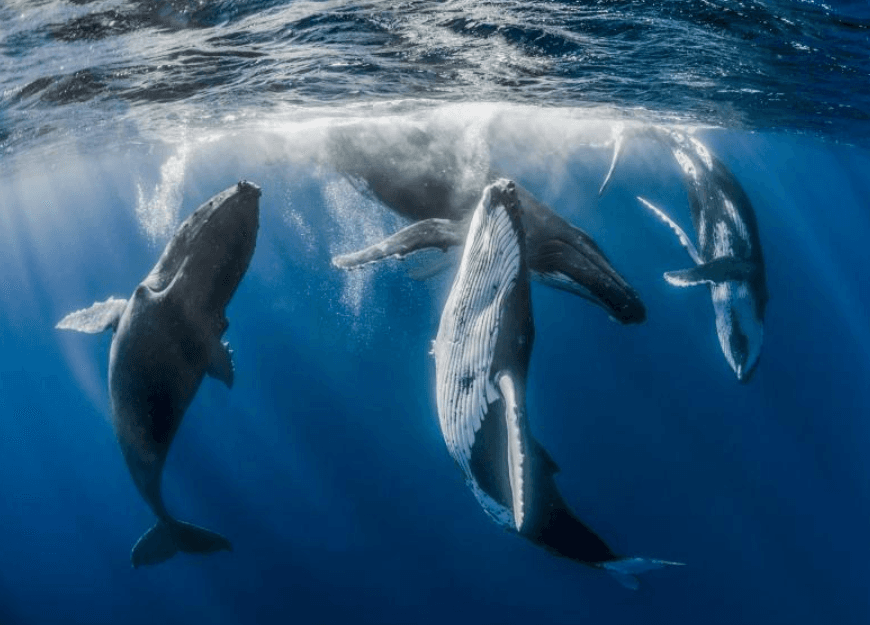
Humpback whales move through water using coordinated movements of their bodies and tail flukes. Their pectoral fins also contribute to maneuvering and control.
Researchers can investigate these movements through observations, underwater video, and suitable tracking instruments.
By examining body motion, scientists can estimate characteristics such as movement frequency, changes in orientation, and patterns of acceleration. These measurements help explain how a whale produces movement and how its swimming behavior changes.
For instance, researchers may compare the motion recorded during steady swimming with movement during a rapid turn or an acceleration.
However, visible movement alone does not provide an exact measurement of energy expenditure. The same apparent motion may require different muscular effort under different conditions.
Scientists must combine movement measurements with biomechanical information or other evidence to estimate the energy associated with the activity.
2. Understanding the Role of Tail Flukes
The tail flukes play a central role in humpback whale propulsion.
During swimming, the whale moves its tail vertically, pushing against the surrounding water. This action produces forces that propel the animal forward.
Scientists interested in energy use may study the frequency, amplitude, and timing of these movements. These characteristics help describe how the whale generates thrust and how its swimming pattern changes.
A whale moving slowly may use a different tail-beat pattern from one accelerating or maneuvering. Researchers can investigate these differences to understand the mechanical demands of different activities.
Nevertheless, tail movement is not a direct energy meter. Estimating the energy associated with propulsion also requires information about the forces involved and how efficiently muscular work is converted into forward motion.
A complete analysis may need to account for the whale’s body shape, movement through water, and surrounding flow conditions.
3. How Water Resistance Affects Energy Use
Water creates resistance when an animal moves through it. This resistance is commonly discussed in terms of hydrodynamic drag.
The amount of drag depends on several factors, including the animal’s shape, its speed relative to the water, and the flow around its body.
As a whale moves faster, the forces opposing its movement can increase substantially. The precise relationship depends on the flow conditions and other physical factors.
To investigate the energy required for swimming, researchers may use biomechanical models to estimate the forces acting on the whale. These models can help explain why maintaining a particular speed may require considerable mechanical power.
Body shape also matters. Humpback whales have long pectoral fins and distinctive body proportions that influence how they maneuver through the water.
Researchers can study these features to understand the relationship between body design, movement, and hydrodynamic performance.
However, models based on body shape and swimming speed remain estimates. Real swimming involves changing body positions, tail movements, and complex water flow that may be difficult to represent fully in a simplified calculation.
4. Using Tracking Data to Study Swimming Effort
Scientific tracking instruments can help researchers investigate the movement patterns associated with energy use.
Depending on the equipment, tracking tags may record acceleration, orientation, depth, or other movement-related variables. Researchers can analyze these measurements to identify changes in swimming behavior.
For example, repeated acceleration measurements may help reveal differences between relatively steady movement and more vigorous activity.
Depth records may also help researchers distinguish portions of a dive from periods spent nearer the surface. When combined with other measurements, these observations can provide context for investigating the physical demands of different behaviors.
However, movement sensors do not automatically measure the number of calories a whale burns. Their readings must be interpreted using suitable models and, where possible, validated against independent physiological or biomechanical evidence.
Tracking tags also have practical limitations. They may record only a limited period, and the collected data may not represent every behavior an animal performs during its daily life.
Tagging requires specialist expertise, appropriate authorization, and careful attention to animal welfare.
5. Why Swimming Speed Alone Cannot Reveal Energy Use
Swimming speed is useful for understanding whale movement, but it cannot independently determine energy expenditure.
Imagine two hypothetical humpback whales swimming at the same speed. One may maintain a relatively steady movement pattern, while the other repeatedly changes direction or accelerates.
Although their average speeds might be similar, their movement patterns could create different mechanical demands.
Body size, body condition, currents, and other factors may also influence the energy required for a particular activity.
Researchers therefore need more than a single speed measurement to estimate energy expenditure. They may combine speed with movement data, biomechanical models, and information about the animal’s physiology.
It is also important to distinguish swimming speed relative to the surrounding water from movement relative to a fixed point on the seabed. Currents can affect these measurements differently.
A reliable estimate depends on choosing the appropriate reference frame and accounting for the factors that influence movement.
6. Can Scientists Measure Whale Metabolism Directly?
Metabolism describes the biological processes through which an animal uses energy. Measuring metabolic energy expenditure in free-swimming whales is challenging because researchers cannot easily collect the same types of continuous measurements available in some laboratory animals.
Scientists may use physiological information, validated models, and indirect indicators to investigate metabolic demands.
The appropriate method depends on the research question, the species, and the data available. Some techniques can provide information about particular physiological processes, while others estimate energy expenditure from observed activity or other measurements.
It is important not to confuse a model-based estimate with a direct measurement of total metabolism.
For example, a model may estimate the mechanical power associated with swimming. Translating that value into metabolic energy requires assumptions about how efficiently the animal’s muscles convert metabolic energy into mechanical work.
Researchers must account for these differences when interpreting or comparing results.
There is no single simple measurement that reveals every aspect of a free-swimming humpback whale’s energy use.
7. Does Diving Change the Energy Demands of Swimming?
Diving introduces additional physical and physiological considerations.
A whale may change its depth, swimming pattern, and activity during a dive. These changes influence the mechanical work associated with movement, while the animal’s physiology must also accommodate periods underwater.
Researchers can investigate these demands by comparing movement data across different portions of a dive.
For example, a study could examine whether recorded tail movements and acceleration patterns differ during descent, horizontal travel, and ascent. Such measurements could help characterize how swimming behavior varies throughout the dive.
However, the energy required for a dive cannot be determined from depth alone. A deeper dive does not automatically mean that the whale used a particular amount of energy.
The route, duration, swimming pattern, water conditions, and physiological responses may all matter.
Researchers therefore need to consider the whole activity rather than treating maximum depth as a direct measure of energy expenditure.
8. How Feeding and Migration Relate to Energy Budgets
Humpback whales undertake different activities during their annual cycle, and these activities can create different energy demands.
During feeding periods, whales consume prey that contributes to their energy reserves. During migration and other periods when feeding opportunities may be limited, stored energy can help support ongoing biological needs.
Scientists can study these broader energy budgets by combining information about body condition, feeding behavior, movement, and physiological processes.
Movement measurements may help estimate the energetic demands of traveling, while observations of feeding provide context for energy acquisition.
Yet a whale’s energy budget involves more than swimming. It includes maintenance of the body, reproduction, and other biological processes.
Researchers should not assume that a particular swimming pattern directly reveals how much stored energy a whale has or how long it can continue traveling.
Understanding energy budgets requires integrating multiple kinds of evidence across suitable time periods.
9. What Could Energy Research Tell Us About Humpback Whales in Samaná?
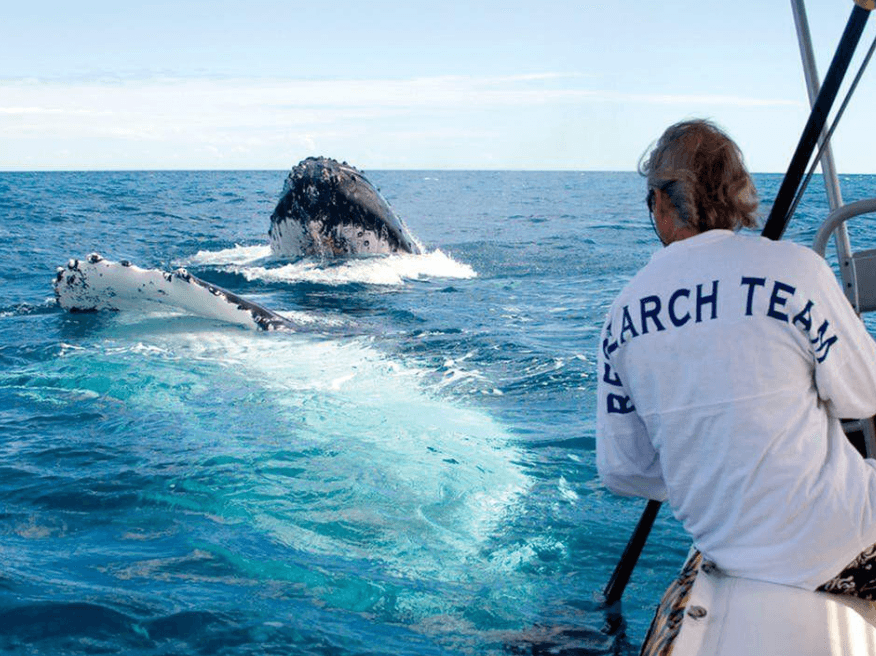
Samaná Bay is an important destination for observing humpback whales during the breeding season. Visitors may see whales swimming near the surface, diving, maneuvering, or raising their flukes before descending.
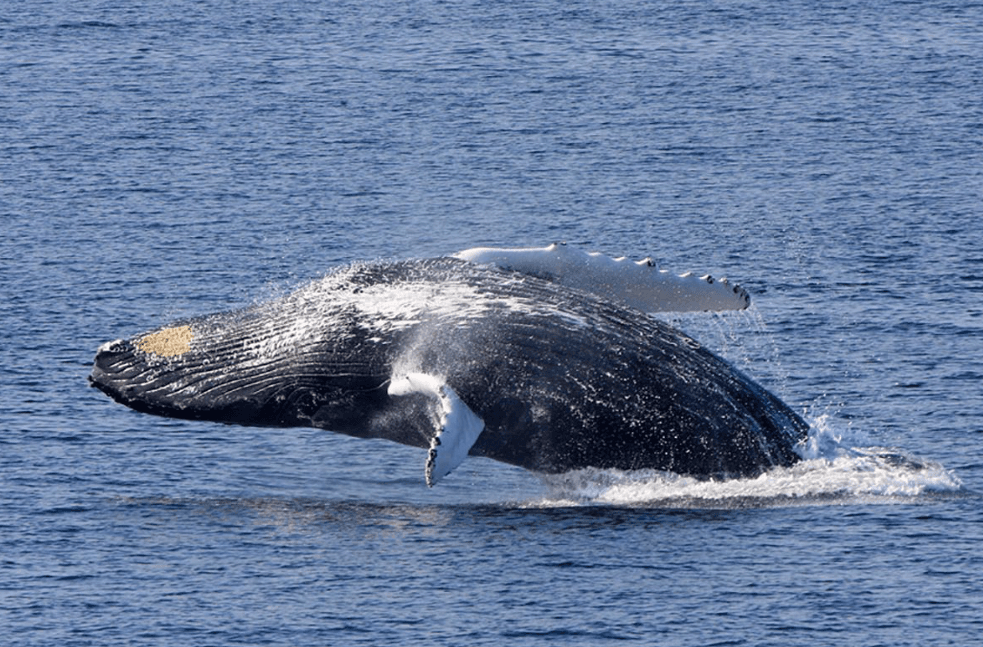
These behaviors are visually impressive, but their energetic costs cannot be measured accurately by observation alone.
A scientific study designed for the Samaná region could investigate questions about movement patterns, the mechanical demands of different behaviors, or how environmental conditions relate to swimming activity.
Researchers would need suitable measurements and a clear method for estimating the energy associated with the behavior under investigation.
The general techniques described in this article do not establish that a specific whale energy-expenditure study has been conducted in Samaná Bay.
They do, however, show how researchers could approach questions about the physical demands of swimming in a breeding-ground environment.
For visitors, the key insight is that a whale’s graceful movement is supported by complex biological and mechanical processes that scientists are still working to understand in detail.
10. What Can Whale Watchers Learn From This Science?
Watching a humpback whale move through the ocean can reveal aspects of its behavior, including changes in direction, diving, and surfacing.
Understanding the science of energy use adds another layer to these observations. It reminds us that movement requires the coordinated action of muscles, body structures, and the surrounding water.
At the same time, it is important to recognize the limits of what can be concluded from a surface sighting. A whale’s apparent speed, the height of its tail movement, or the length of a dive does not provide a precise measurement of energy expenditure.
Responsible whale watching focuses on observing natural behavior without disturbing the animals.
Follow your guide’s instructions and applicable wildlife-viewing rules, and avoid trying to approach a whale to observe its movements more closely. Giving the animals space allows them to continue their natural activities.
Conclusion: Understanding the Energy Behind Whale Movement
Scientists investigate humpback whale energy use through a combination of biomechanics, movement measurements, physiological information, and mathematical models.
Studying tail movements helps explain propulsion, while tracking data can reveal patterns of acceleration and changes in activity. Hydrodynamic models help researchers investigate the forces involved in moving through water, and physiological evidence may help connect mechanical activity with metabolic demands.
Each approach has limitations, and no single measurement automatically reveals the total energy a whale uses while swimming.
For anyone interested in Samaná whale watching, this research provides a deeper appreciation of the physical processes behind humpback whale movement. The graceful motion visible from a boat is only one part of a complex system involving muscles, body mechanics, and the ocean itself.
Planning a whale-watching experience in Samaná? Learn about the seasonal viewing period, choose a responsible operator, and follow local wildlife-viewing guidance. Observing humpback whales respectfully is a wonderful way to appreciate their natural behavior while helping protect the environment they depend on.

Local explorer & expert guide in Salto El Zumbador.