How Do Humpback Whales Communicate Sounds, Signals, and Social Behavior
Humpback whales are famous for their complex vocalizations, but sound is only one part of how these marine mammals interact with one another. They also use body movements, changes in position, and physical displays that researchers study to better understand whale behavior.
So, how do humpback whales communicate? They communicate through a combination of sounds and visible behaviors. These signals may play roles in social interactions, reproduction, and other activities, although scientists cannot always determine the exact meaning of a particular sound or movement.
For visitors watching whales in Samaná Bay, Dominican Republic, understanding communication makes every encounter more interesting. A whale surfacing beside another whale, changing direction, or making a visible display may be participating in a social interaction—but its exact intention may not be obvious.
This guide explores the main ways humpback whales communicate, how researchers study their signals, and what travelers can learn from observing these animals responsibly.
1. How Do Humpback Whales Communicate With Sound?
Sound is an important part of communication for humpback whales. Underwater, sound can travel over considerable distances, making it useful in an environment where visibility may be limited.
Humpback whales produce a variety of vocalizations, including low-frequency sounds, repeated calls, and more complex sequences. Researchers record these sounds using specialized underwater microphones called hydrophones.
Scientists examine the characteristics of these vocalizations, such as their frequency, duration, repetition, and pattern. By comparing recordings with observations of whale behavior, they investigate how sounds may be used in different contexts.
However, hearing a sound does not automatically reveal its meaning. Researchers must consider the surrounding circumstances before suggesting what a whale may be communicating.
Why is sound useful underwater?
Water carries sound differently from air, and underwater sound can travel farther than many visible signals under suitable conditions.
This is useful for animals that move through large areas of ocean. Whales may not be able to see every nearby animal, especially when visibility is poor, but acoustic signals can still provide information about activity in their surroundings.
The distance a sound travels depends on factors such as its frequency, strength, water conditions, and background noise.
Do humpback whales make different sounds for different situations?
Humpback whales produce different types of vocalizations, and researchers have documented variations in their acoustic patterns.
Some sounds occur in particular social contexts, while others may be associated with interactions among nearby animals. Yet the precise function of many vocalizations remains uncertain.
It is more accurate to say that humpback whales have a diverse vocal repertoire than to assign a definite human-like message to every sound.
2. Do Humpback Whales Use Body Language?
Yes. Humpback whales display a range of visible behaviors that may provide information during social interactions.
Researchers study movements such as changes in swimming direction, body orientation, flipper movements, and interactions between nearby whales. These observations can help scientists investigate how whales respond to one another.
However, a movement does not always have one fixed meaning. The same behavior may occur in different contexts, and the reason behind a particular action may not be clear from observation alone.
Changes in body position
A whale may turn toward another whale, swim alongside it, or change its position relative to nearby animals.
Such movements may be relevant to social interactions, but the meaning depends on the wider context. A change in direction could reflect a response to another whale, movement through the environment, or another activity.
Researchers therefore consider the entire encounter rather than interpreting a single movement in isolation.
Flipper displays
Humpback whales have exceptionally long pectoral fins. During some encounters, a whale may raise a flipper above the surface or move it forcefully against the water.
These displays can be visually striking, but observers should not assume that every flipper movement is a deliberate message. Researchers investigate whether particular displays are associated with specific social circumstances.
For visitors, the important lesson is that whale behavior is complex and cannot always be translated into a simple explanation.
Surface movements
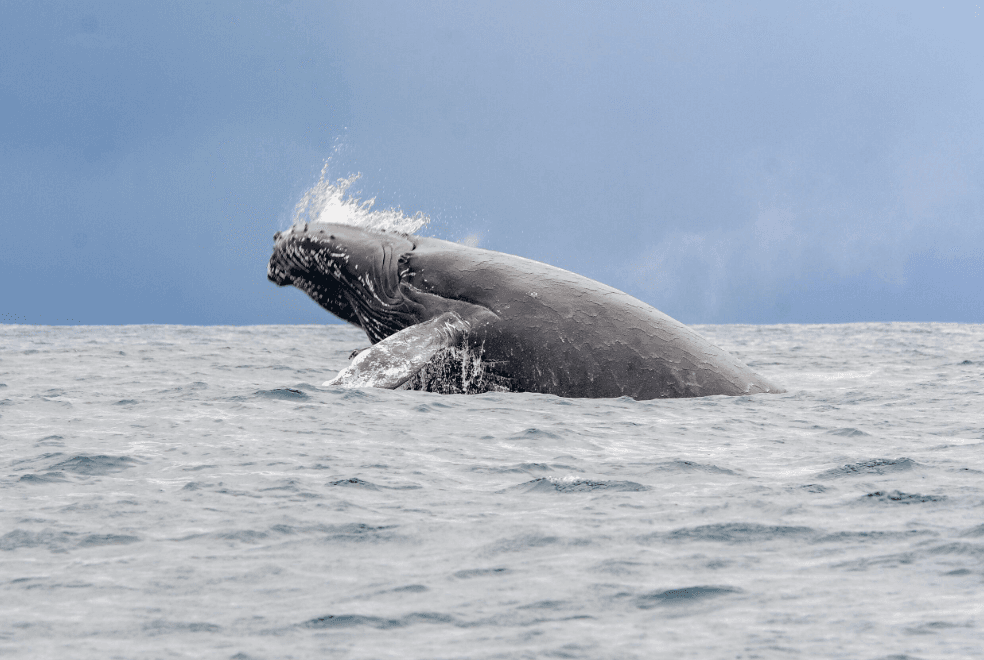
A whale may roll, arch its back, or change its swimming pattern while interacting with other whales.
Such movements provide useful clues for scientists studying social behavior. Still, a surface movement alone does not prove that the whale is communicating a particular message.
Careful observation and scientific research are needed to distinguish possible social signals from other forms of activity.
3. How Do Humpback Whales Communicate With Other Whales?
Humpback whales may encounter other individuals during different stages of their lives. Their interactions can involve sounds, movement, and changes in spacing.
The nature of an interaction depends on the circumstances. Two whales swimming together may be engaged in social behavior, while animals moving through the same area may not be interacting closely at all.
Interactions during the breeding season
Humpback whales gather in breeding areas during particular parts of the year. Samaná Bay is one of the places visited by North Atlantic humpback whales during the winter breeding season.
During this period, researchers may observe social interactions involving multiple whales. Vocalizations and changes in movement can provide information about what is happening, although not every interaction has an obvious interpretation.
For example, an observer may see several whales swimming near one another. Their proximity alone does not reveal whether they are cooperating, competing, or simply moving through the same area.
Communication between mothers and calves
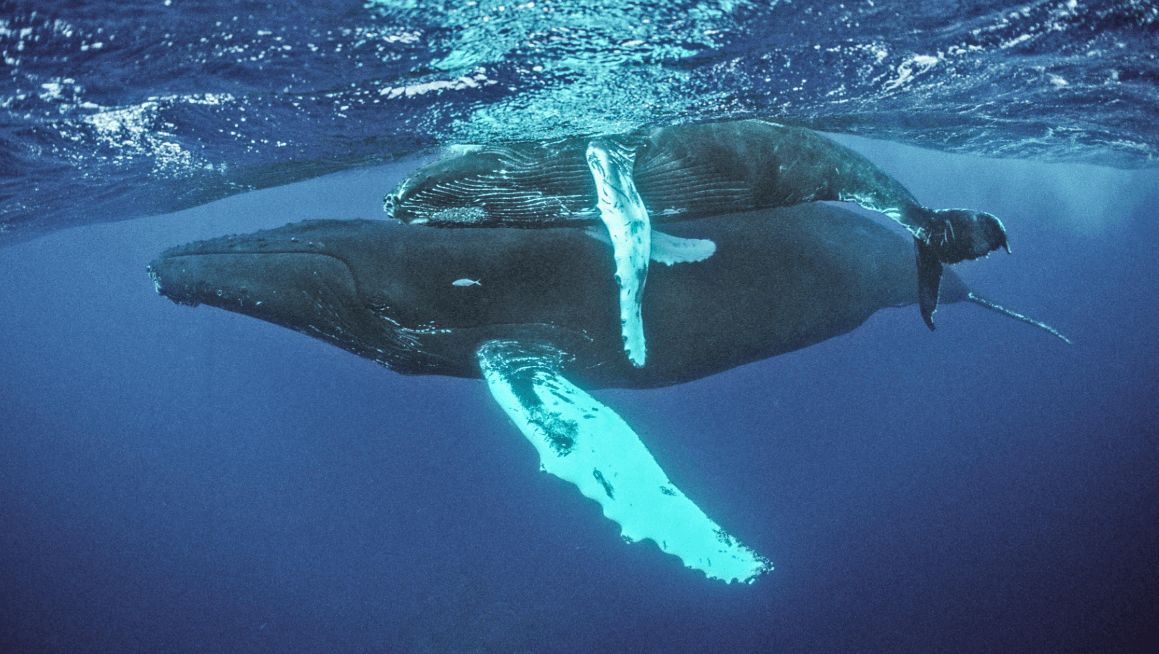
Mother and calf pairs are another important context for studying whale interactions.
A calf remains close to its mother during early development and depends on her for nourishment and protection. Researchers are interested in how mothers and calves coordinate their movements and whether acoustic or other signals help maintain contact.
Observations of mother-calf pairs can provide valuable information, but scientists must avoid assigning specific meanings to sounds or movements without sufficient evidence.
For whale watchers, these encounters are a reminder that the behavior visible at the surface may be part of a more complex interaction.
4. Can Humpback Whales Communicate Over Long Distances?
Under suitable conditions, underwater sounds can travel over long distances. This makes acoustic communication potentially useful for whales that occupy large marine habitats.
However, the distance over which a particular humpback whale vocalization can be detected varies. It depends on the sound itself, background noise, water depth, and other environmental conditions.
Scientists can use hydrophones to detect vocalizations that are not audible to people standing on a boat. By deploying recording equipment in different locations, researchers can investigate when and where whale sounds occur.
Detecting a sound does not necessarily mean that researchers know which whale produced it or which individual received it. Those questions require additional evidence.
It is also important to distinguish the potential range of a sound from the effective range of communication. A sound may travel a long way without providing enough information for researchers to establish what it means to a receiving animal.
5. How Do Scientists Study Humpback Whale Communication?
Studying communication in wild whales requires more than listening to recordings. Researchers combine acoustic data, visual observations, and information about the surrounding environment to investigate patterns of behavior.
Hydrophones
Hydrophones are underwater microphones designed to record sounds in aquatic environments.
Researchers use them to collect recordings of whale vocalizations and analyze acoustic features. The recordings can help identify repeated patterns, compare sounds from different locations, and study changes over time.
Some research programs use fixed recording stations, while others deploy equipment during field studies.
Visual observation
Scientists may record whale movements, group composition, surface activity, and the distance between individuals.
When visual observations are matched with acoustic recordings, researchers can investigate whether particular sounds tend to occur alongside specific behaviors.
This does not automatically establish what a sound means, but it can help researchers test explanations using repeated observations.
Comparing recordings over time
Long-term recordings allow scientists to examine how vocalizations change across seasons and locations.
Researchers may investigate whether certain sounds are associated with particular activities, how acoustic patterns vary among groups, or how background noise affects the ability to detect whale calls.
Such studies contribute to a broader understanding of marine mammal communication.
6. How Does Ocean Noise Affect Whale Communication?
The ocean is not silent. Natural sounds come from waves, weather, geological activity, and marine animals. Human activities also contribute sound through shipping, construction, and other sources.
Depending on its intensity and frequency, underwater noise can overlap with sounds produced by whales. This may make some vocalizations more difficult to detect.
The effects depend on the source of noise, the location, the whale species, and the conditions of the encounter. Not every noise source has the same effect, and the consequences for individual animals can vary.
Why is underwater noise a conservation concern?
If background noise interferes with the detection of relevant sounds, it may make acoustic communication more challenging in some circumstances.
Researchers study these effects to understand the potential consequences for marine mammals and identify ways to reduce avoidable disturbance.
Measures may include managing noisy activities, following applicable marine regulations, and improving understanding of important whale habitats.
Protecting the acoustic environment is one aspect of broader marine conservation, alongside reducing entanglement, ship strikes, and other threats.
7. Can People Hear Humpback Whale Communication During Whale Watching?
Sometimes, but ordinary whale-watching trips do not necessarily include underwater listening equipment.
A whale may produce sounds while a boat is nearby, but most vocalizations occur underwater and may not be audible to passengers above the surface.
Some educational programs or specialized excursions may use hydrophones to let visitors hear underwater recordings. Availability depends on the operator and equipment, so travelers should confirm this feature before booking.
Even when no sound is heard, the absence of audible vocalizations does not mean whales are silent.
What can you observe from the boat?
During an encounter in Samaná Bay, you may observe whales surfacing, changing direction, swimming near other whales, or making visible movements.
These behaviors provide opportunities to learn about whale interactions, but they do not always reveal the exact meaning of a signal.
A knowledgeable guide may explain what researchers have documented while distinguishing established findings from possible interpretations.
Choose an operator that follows applicable wildlife-viewing rules and does not attempt to provoke whales into displaying particular behaviors.
8. Are Humpback Whale Signals Similar to Human Language?
Humpback whales communicate, but their communication should not automatically be equated with human language.
Human language involves complex systems of symbols, grammar, and shared conventions. Researchers are still investigating the structure, function, and meaning of many whale vocalizations.
Whale sounds can show patterns and repetition, and some acoustic behaviors have complex structures. However, finding patterns in a recording does not by itself demonstrate that the sounds function like human words or sentences.
Scientists continue to study how whales produce and respond to sounds, how their vocal behavior varies among populations, and what information may be conveyed.
It is reasonable to describe humpback whales as communicative and socially complex animals without claiming that their vocalizations translate directly into human speech.
Frequently Asked Questions
How do humpback whales communicate with each other?
They use sounds and visible behaviors, including vocalizations, changes in body position, and movements during social encounters. The exact meaning of many signals remains under investigation.
Do humpback whales communicate through touch?
Physical contact may occur during some interactions, but the function of a particular contact depends on the circumstances. Researchers should not assume that every touch has a specific communicative meaning.
Can humpback whales hear each other underwater?
Humpback whales are adapted to an underwater acoustic environment and can detect sounds. Researchers study their hearing and vocalizations to better understand how acoustic information is used.
Can humans hear humpback whale sounds?
Some whale sounds may be audible under certain conditions, but many underwater vocalizations are not easily heard from a boat. Hydrophones can record sounds that passengers would otherwise miss.
Do humpback whales communicate with their calves?
Mothers and calves interact closely, and researchers investigate the role of sound and other signals in these relationships. The exact meaning of particular calls or movements is not always known.
Does ocean noise affect humpback whales?
Underwater noise can interfere with the detection of some sounds, depending on its characteristics and the surrounding conditions. Researchers continue to investigate the effects on whale behavior and communication.
Can I hear whale sounds in Samaná Bay?
It depends on the excursion and equipment. Most ordinary whale-watching trips focus on observing whales at the surface. Ask the operator whether an underwater hydrophone is available if hearing whale sounds is important to you.
Conclusion: Understanding Humpback Whale Communication
Humpback whales communicate through a combination of vocalizations and visible behaviors. Their sounds can travel through the underwater environment, while movements and social interactions provide additional clues about their behavior.
Scientists use hydrophones, visual observations, and long-term studies to investigate how these signals work. Although much has been learned, the meaning of many individual sounds and movements remains uncertain.
For visitors to Samaná Bay, learning about whale communication adds another dimension to observing these remarkable marine mammals. A whale encounter is not simply a chance to see a large animal; it is also an opportunity to appreciate the complex behaviors that scientists continue to investigate.
The best approach is to remain curious, respect the whales' space, and enjoy observing their natural behavior without assuming that every movement or sound has a definite meaning.

Local explorer & expert guide in Salto El Zumbador.