How Do Humpback Whale Calves Learn to Swim in Samaná Bay?
Every whale begins life with a remarkable challenge: learning to survive in the ocean. For a newborn humpback whale, that means swimming alongside its mother, reaching the surface to breathe, nursing for energy, and gradually building the strength needed for a long journey through open water.
Samaná Bay in the Dominican Republic is known as an important seasonal area for humpback whales. During the winter breeding season, visitors may have the opportunity to see mothers and calves traveling together in the bay. These encounters offer a glimpse into the early life of one of the ocean's most impressive marine mammals.
But how does a young whale learn to swim What does its mother teach it, and why is staying close to her so important?
Why Are Humpback Whale Calves Born in Warm Waters?
Humpback whales migrate between feeding areas in colder waters and breeding areas in warmer tropical or subtropical regions. Samaná Bay is one of the Caribbean locations associated with their winter breeding season.
Female humpback whales typically give birth after a gestation period of about 11 months. The warm waters of breeding areas provide an environment where newborn calves can spend their early weeks without facing the colder conditions found in many feeding grounds.
Warm water does not mean that survival is effortless. A newborn calf still needs to breathe regularly, maintain its energy, grow quickly, and remain close to its mother. Its early development depends heavily on nursing and maternal care.
Can a Newborn Humpback Whale Swim Immediately?
Newborn humpback whale calves are capable of swimming soon after birth. They are mammals, not fish, so they must come to the surface to breathe air through their blowholes.
Although a calf can swim early in life, that does not mean it is immediately as strong or efficient as an adult. Its movements, stamina, and coordination continue to develop as it grows.
Swimming beside a much larger adult can also be demanding. The calf must keep up while conserving energy, surfacing to breathe, and responding to changing conditions around it.
A mother may adjust her movements to help her calf remain nearby. Observers should not assume that every change in speed or direction is deliberate teaching, however. Many behaviors are part of the natural interaction between mother and young.
How Does a Calf Stay Close to Its Mother?
Staying near its mother is one of the most important parts of a calf's early life. The mother provides milk, protection, and the close contact the young whale needs during its development.
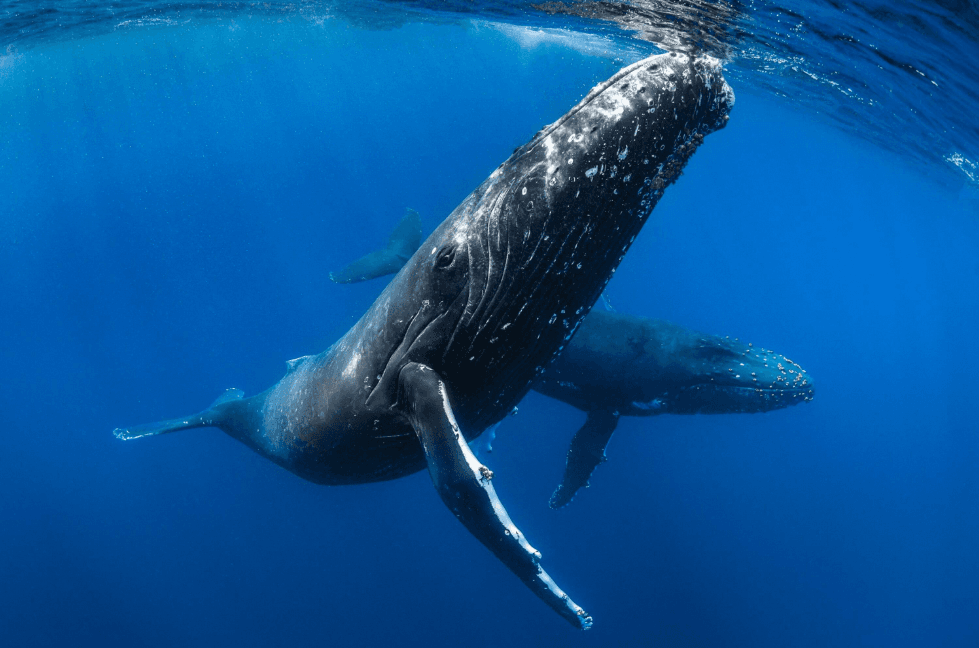
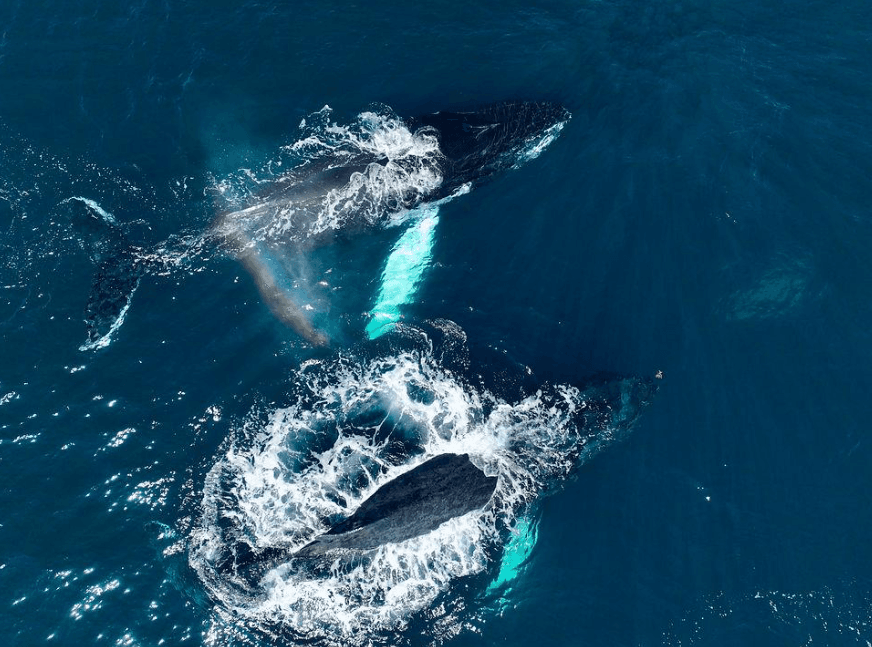
A calf may swim beside or slightly behind its mother. Their positions can change as they travel, rest, surface, or move through the water. The pair may sometimes appear to move almost as one, although the calf still needs to coordinate its own swimming and breathing.
Close contact can help the calf conserve energy and remain near a reliable source of nourishment. It also allows the mother to monitor the young whale's movements.
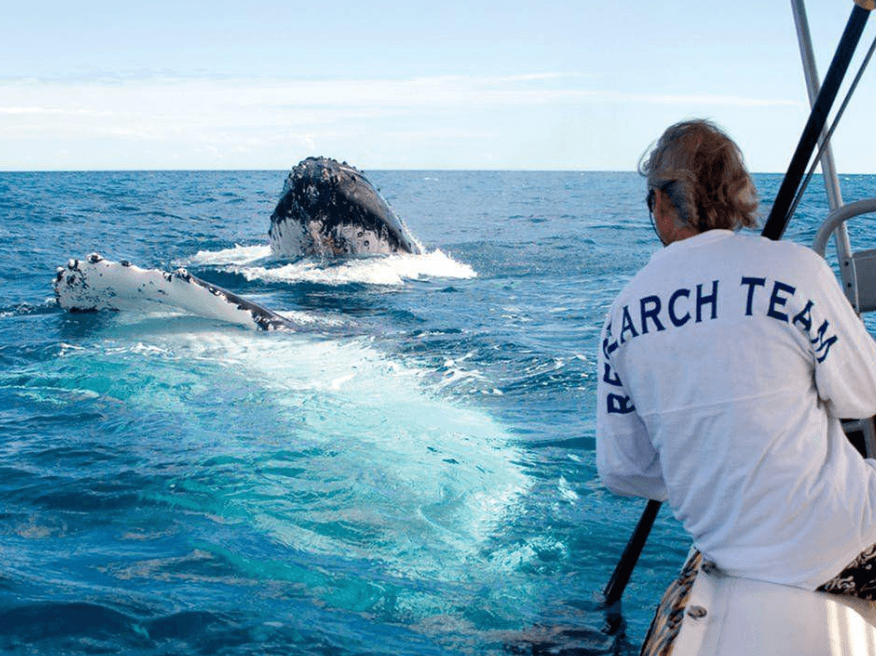
For whale watchers, seeing a mother and calf together can be a memorable experience. It is important to observe them quietly from a responsible distance. Boats should never attempt to separate the pair, cut between them, or chase a calf to obtain a closer view.
How Do Humpback Whale Calves Learn to Breathe?
Unlike fish, humpback whales cannot extract oxygen from water. They breathe air through blowholes located on top of their heads.
A newborn calf must surface regularly to breathe. Surfacing and submerging become part of its everyday routine, alongside swimming and nursing.
As the calf grows, it develops greater strength and control over its movements. Its breathing and swimming patterns may change with activity and rest. These patterns are not identical for every calf, and a brief observation from a boat cannot reveal everything about a young whale's health or development.
When watching whales in Samaná Bay, visitors may notice a calf surfacing near its mother. What looks like a simple movement is an essential part of life for an air-breathing marine mammal.
Why Is a Mother's Milk So Important?
Humpback whale calves depend on their mothers' milk for nourishment during their early months. Whale milk is rich in fat, helping calves gain the energy and body mass needed for growth.
Nursing supports more than size alone. A growing calf needs energy to develop its muscles, strengthen its swimming ability, and prepare for the demands of migration.
The mother must also maintain her own energy while caring for the calf. During the breeding season, humpback whales generally feed much less than they do in their colder-water feeding areas, relying heavily on energy reserves accumulated earlier.
This makes the mother-calf relationship especially important. The calf's growth and the mother's condition are closely connected.
How Does a Calf Build Strength and Coordination?
A calf's swimming ability develops through movement and experience. It must coordinate its body, control its direction, surface for air, and remain close enough to its mother to nurse and travel together.
As it grows, the calf gains strength and endurance. Its movements may become more controlled, although young whales can still appear less steady or less synchronized than adults.
It is tempting to interpret every movement as a lesson, but scientists cannot determine the purpose of every action from a brief sighting. Calves develop through growth, repeated activity, and their relationship with their mothers; not every behavior is a deliberate training exercise.
The most useful way to understand calf development is to consider the full picture: physical growth, nursing, maternal care, and gradually increasing swimming ability.
How Long Do Humpback Whale Calves Stay With Their Mothers?
Humpback whale calves typically remain dependent on their mothers for several months. They nurse during this period and gradually become more capable swimmers.
Many calves accompany their mothers on the migration from tropical breeding grounds toward colder feeding areas. The journey is a major stage in early life because it involves traveling over long distances while continuing to grow.
The exact timing of weaning and separation can vary. It is best not to assume that every mother-calf pair follows an identical schedule or that a calf seen in Samaná is at the same stage of development as another calf.
For visitors, this means that whale-watching encounters can vary throughout the season. Some sightings may involve a mother and calf resting or moving slowly, while others may show the pair traveling through the bay.
Why Is Samaná Bay a Special Place to Observe Mother-Cow Relationships?
Samaná Bay and the surrounding waters are part of the Dominican Republic's seasonal humpback whale habitat. During the winter breeding season, whales gather in the wider region for reproductive activities, and mothers with calves may be present.
Seeing a young whale beside its mother helps visitors understand that whale watching is not only about spectacular surface displays. It can also be an opportunity to appreciate animal development, maternal care, and the challenges faced by young marine mammals.
However, a calf is not guaranteed on every excursion. Whale sightings depend on natural conditions, whale movements, and the timing of a visit. Responsible operators should explain these uncertainties rather than promise a particular animal behavior.
If observing a mother and calf is important to you, ask a tour operator about its wildlife-viewing practices and how it minimizes disturbance to whales.
How Can Visitors Protect Young Whales During a Tour?
Mother-calf pairs need space. Close approaches, loud activity, or attempts to follow a pair for too long may interfere with their natural behavior.
Choose a tour operator that follows applicable whale-watching regulations and local guidance. Keep these principles in mind:
- Respect required distances and approach rules.
- Never ask a captain to chase, surround, or cut between a mother and calf.
- Avoid shouting or making unnecessary noise to attract a whale's attention.
- Follow the crew's instructions and remain seated when required.
- Take photographs without pressuring the boat to move closer.
- Understand that a responsible operator may change its route or leave an encounter to protect the animals.
Responsible whale watching puts the welfare of the whales ahead of obtaining a close-up photograph. Giving a mother and calf space helps preserve the experience for wildlife and future visitors.
What Should You Look for When You See a Whale Calf?
If a calf appears during your trip, watch calmly and look at the broader interaction rather than focusing only on the young whale.
You may notice the calf surfacing near its mother, swimming alongside her, or changing position as the pair moves. You might also see them travel at different depths or disappear below the surface for a period.
These observations can help you appreciate the relationship, but they do not provide a complete assessment of the calf's age, health, or development. Avoid interpreting a single movement as proof that the animal is distressed, tired, or learning a specific skill.
A knowledgeable guide can provide context while making clear what is known and what cannot be concluded from a short sighting.
Plan a Responsible Samaná Whale-Watching Experience
Seeing humpback whales in Samaná can be an opportunity to learn about migration, reproduction, and the early lives of young whales. A mother and calf traveling together may be especially moving because it shows the care and dependence involved in the first months of a whale's life.
Before booking, review the tour's departure location, duration, inclusions, safety guidance, and wildlife-viewing policies. Choose an excursion that explains its practices clearly and respects the natural behavior of the animals.
Remember that no tour can guarantee a sighting of a calf or a particular behavior. The best experience combines realistic expectations, a knowledgeable crew, and respect for marine wildlife.
Final Thoughts
Humpback whale calves develop their swimming ability through early movement, physical growth, nursing, and close association with their mothers. They must learn to coordinate swimming and breathing while gaining the strength needed for life in the open ocean.
Samaná Bay offers a seasonal opportunity to observe humpback whales in their natural environment, including mother-calf pairs when they are present. By watching patiently and choosing responsible whale-watching practices, visitors can appreciate these early stages of whale life without interfering with them.
Interested in seeing humpback whales in Samaná? Explore available local whale-watching excursions, confirm the departure details and wildlife policies with the operator, and plan your visit with respect for these remarkable animals.
Editorial note: Confirm current seasonal dates, tour details, and applicable wildlife-viewing rules with reliable local or official sources before publication. Do not promise that a calf will be present on a particular trip.

Local explorer & expert guide in Salto El Zumbador.