How Do Scientists Determine Whether Humpback Whale Songs Spread Through Social Learning?
Humpback whales produce elaborate songs made up of repeated sounds and organized sequences. These vocal patterns can change over time, and researchers have documented cases in which song patterns spread through whale populations. Such findings raise an important question: how do scientists determine whether whales learn song patterns from other whales?
The answer involves long-term acoustic recordings, detailed comparisons of song structure, observations of whale movements, and evidence showing how vocal patterns appear and change over time.
Samaná Bay in the Dominican Republic is a seasonal destination for humpback whales. Researchers studying whale communication in this region could use these methods to investigate local vocal patterns and compare them with suitable recordings from other locations. However, any specific conclusion about social learning in Samaná Bay would require verified local data.
What Is Social Learning in Humpback Whales?
Social learning occurs when an animal acquires information or changes its behavior through exposure to other individuals or their behavior.
In humpback whales, researchers investigate social learning by examining how song patterns spread, persist, or change among singers. When whales produce similar vocal sequences and those patterns appear to spread through a population, cultural transmission becomes one possible explanation.
Cultural transmission is different from genetic inheritance. A genetically inherited trait is passed through biological reproduction, whereas a culturally transmitted behavior can spread through learning and social interaction.
Scientists cannot directly observe every learning event in wild whales. Instead, they examine patterns in acoustic recordings and other evidence to determine which explanations are best supported.
1. Recording Whale Songs Over Extended Periods
Long-term acoustic monitoring is one of the most important tools for studying possible social learning.
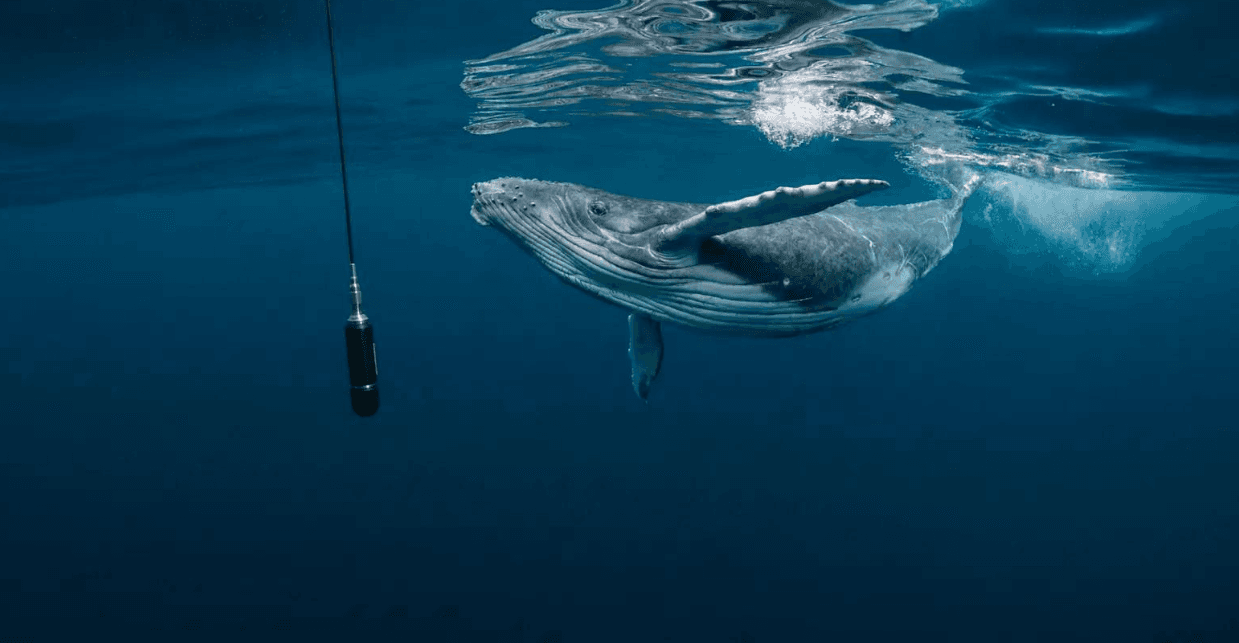
Researchers use underwater microphones called hydrophones to record whale vocalizations. These recordings can be collected from fixed monitoring stations, research vessels, or other suitable platforms.
Repeated recordings allow scientists to track the appearance and persistence of song patterns. They can investigate whether a particular phrase is present in one period, appears later in another recording, and subsequently becomes more common.
A single recording usually provides too little information to establish such a pattern. Researchers need enough observations to distinguish a genuine change from an event that was simply missed during earlier sampling.
For research involving Samaná Bay, recordings should include accurate dates, locations, recording settings, and information about data gaps. These details help scientists compare observations fairly and evaluate the reliability of any apparent trend.
2. Identifying Song Patterns That Could Be Learned
Humpback whale songs contain individual sound units, repeated phrases, and larger sequences. Scientists analyze these components to identify patterns that recur across recordings.
Spectrograms help researchers visualize how frequencies change over time. Analysts can compare the shape, duration, frequency contour, and sequence of sounds.
A song may contain a distinctive combination of units that makes it easier to recognize across different recordings. Researchers can track how often that combination occurs and whether its structure remains similar.
However, not every shared sound proves social learning. Some acoustic features may be common across many songs, while other similarities may arise from natural variation.
The strongest evidence comes from examining multiple features and longer sequences rather than relying on one broadly similar sound.
3. Tracking When New Song Patterns Appear
The timing of a new song pattern can help scientists investigate possible learning.
Suppose researchers repeatedly record one song pattern in a particular group, then later identify a similar and distinctive pattern in another group. If the pattern subsequently becomes more common in the second group, this sequence may support a hypothesis of cultural transmission.
But researchers must first consider whether the pattern was genuinely absent from earlier recordings. Incomplete monitoring can make an existing song appear new.
Scientists may review archived recordings, compare observations from multiple dates, and define clear criteria for identifying the pattern.
They also need to distinguish the earliest documented appearance from the actual moment when a pattern began to occur. The first available recording may simply be the first time researchers captured it.
A reliable timeline helps establish whether the observed pattern is consistent with social learning, although timing alone does not prove the mechanism.
4. Comparing Song Structure Across Individuals
Researchers can investigate whether different singers produce similar patterns by comparing the acoustic structure of their songs.
When possible, recordings may be associated with individual whales through synchronized observations or other reliable evidence. This can help scientists examine whether a song pattern occurs in multiple individuals.
However, assigning an underwater vocalization to a particular whale can be difficult, especially when several animals are nearby or their songs overlap.
If individual identity is uncertain, researchers should describe the findings at the recording or group level rather than claiming that a specific whale learned from another.
Comparing individual singers can provide valuable evidence, but only when the link between each recording and the identified whale is sufficiently reliable.
5. Distinguishing Social Learning From Individual Variation
Whale songs may differ because individual singers vary in how they produce vocalizations. Differences can also occur because recordings capture different portions of a song.
A researcher may observe a new-looking sound unit and initially consider whether it represents a learned change. Before reaching that conclusion, the researcher must evaluate other explanations.
For example, the sound may be an uncommon variation of an existing unit, a previously overlooked feature, or an artifact caused by recording noise.
Scientists can reduce uncertainty by comparing repeated examples, reviewing original recordings, and applying consistent classification rules.
A pattern becomes more informative when it appears repeatedly across singers and over time in a way that is difficult to explain through ordinary variation alone.
Even then, the evidence should be described carefully, especially when the learning process itself has not been directly observed.
6. Investigating Whether Whale Movement Helps Explain Learning
Social learning requires some plausible way for information or behavior to spread, but the exact pathway may not be obvious in wild whale populations.
Researchers can use independent movement data to investigate whether whales from different groups may encounter one another. Such information may come from photo-identification, satellite tracking, visual surveys, or other suitable methods.
If a distinctive song pattern appears in one area and later occurs in another area connected by documented whale movements, the findings may support a transmission hypothesis.
However, movement does not prove that a particular song was learned during a specific encounter. Nor does song similarity alone establish that two groups met.
Scientists combine acoustic timelines with movement evidence to assess plausible explanations without claiming more than the data demonstrate.
7. Using Computer Analysis to Detect Similarities
Modern acoustic software can help researchers compare large collections of whale-song recordings.
Tools may extract frequency contours, measure sound duration, identify repeated units, or calculate similarity between sequences. Machine-learning systems can also help flag recordings that may contain related patterns.
These methods are valuable because manually reviewing thousands of hours of audio can be time-consuming.
However, automated systems can make mistakes. Background noise, differences in equipment, and incomplete recordings may influence their results. A similarity score also depends on which features the algorithm measures.
Scientists should validate automated classifications using carefully reviewed examples and retain the original recordings for independent checking.
Computer analysis can identify candidate patterns for further investigation, but it cannot independently prove that a whale learned a song from another whale.
8. Understanding the Difference Between Cultural Transmission and Genetic Inheritance
A key scientific question is whether song patterns are learned socially or explained by other mechanisms.
If a vocal pattern spreads rapidly across a group over a relatively short period, that pattern may be difficult to explain through genetic change alone. Researchers can compare the speed and distribution of the change with what would be expected under alternative explanations.
Evidence of recurring song patterns among different individuals and their changing distribution over time can support a cultural-transmission hypothesis.
Nevertheless, scientists must be cautious about drawing conclusions from song similarity alone. Biological relationships, shared environmental conditions, and other influences may affect the patterns being studied.
Genetic data, when relevant and available, can provide additional context, but it does not replace acoustic and behavioral evidence about how songs are produced and spread.
9. Comparing Social Learning Across Breeding Seasons
Humpback whales may change their songs over time. Comparing multiple breeding seasons can help researchers investigate whether song patterns persist, become less common, or appear in new combinations.
A long-term study could track a defined song feature across successive seasons and record how frequently it appears in each dataset.
If a distinctive pattern is detected in one season and becomes widespread in later recordings, researchers can investigate whether that change is consistent with social learning.
However, the number of recordings, the number of singers, and the quality of the data can vary between seasons. A pattern may appear to become more common simply because researchers sampled a different set of whales.
Standardized sampling and clear reporting are essential for determining whether a trend is meaningful.
10. Why Researchers Need Multiple Lines of Evidence
Social learning is a scientific explanation that should be supported by more than one observation.
Acoustic recordings can show that song patterns are similar or change over time. Movement records can help investigate connections between locations. Visual observations may provide context about which whales were present.
Each type of evidence answers a different question.
For example, acoustic recordings may establish when a distinctive song sequence was detected. Movement data may indicate that connections between two areas are plausible. Repeated observations may reveal that the pattern subsequently occurs in more singers.
Together, these findings may provide a stronger case for cultural transmission than any single dataset could provide.
Researchers should also report competing explanations and explain why the evidence supports one interpretation more strongly than another.
11. What Social-Learning Research Could Explore in Samaná Bay
A potential research program in Samaná Bay could collect repeated recordings of humpback whale songs and compare them with suitable regional datasets.
Researchers could investigate whether distinctive patterns recur across multiple seasons, whether their distribution changes over time, and whether independent evidence helps explain connections among recording locations.
They might also examine how differences in sampling effort affect the apparent prevalence of particular song patterns.
These investigations would require verified recordings, consistent classification methods, and careful consideration of alternative explanations.
The presence of humpback whales in Samaná Bay does not itself demonstrate that a specific song has been socially learned or transmitted locally. Such conclusions must follow from evidence collected and analyzed for that purpose.
12. Why Social Learning Matters for Whale Communication
Research on social learning helps scientists understand how complex communication patterns can change within animal populations.
If song patterns spread between individuals or groups, they may reveal aspects of whale social behavior that cannot be understood through anatomy or genetics alone.
This research can also help explain why whale songs are not necessarily fixed, unchanging signals. Instead, some aspects of vocal behavior may vary and spread over time.
Nevertheless, evidence of social learning does not directly measure whale abundance, reproductive success, or conservation status. Those questions require separate methods and supporting data.
For whale-watching destinations such as Samaná Bay, accurate explanations of whale communication can improve public understanding while maintaining a clear distinction between established findings and proposed local research.
Conclusion
Scientists investigate social learning in humpback whale songs by tracking acoustic patterns over time, comparing sequences among singers, and evaluating whether changes are consistent with cultural transmission.
Long-term recordings, reliable song classification, movement data, and repeated observations can strengthen the evidence. Researchers must still consider individual variation, recording limitations, and alternative explanations.
For Samaná Bay, these methods provide a framework for future research into whale communication. Any claim about a particular local learning event or song-sharing pattern should be supported by verified data rather than inferred from general knowledge about humpback whales.
Frequently Asked Questions
Do humpback whales learn songs from other whales?
Research has documented song patterns that spread among humpback whale groups in some populations, supporting cultural transmission as an important explanation for certain changes. The exact learning process and pathway may vary and require careful investigation.
How can scientists tell whether a song was learned socially?
They examine the timing, structure, and spread of distinctive song patterns, then compare those findings with evidence about whale movements and other possible explanations.
Can researchers directly observe whales learning songs?
Directly observing the full learning process in wild whales is challenging. Scientists often infer social learning from repeated acoustic patterns and their distribution over time.
Is social learning the same as genetic inheritance?
No. Social learning involves acquiring behavior through exposure to others, while genetic inheritance involves traits passed through biological reproduction.
Can artificial intelligence prove that whale songs are socially learned?
No. Automated tools can help detect similarities and track patterns, but establishing social learning requires interpretation and supporting evidence beyond an algorithm's classification.
Has social learning been confirmed specifically in Samaná Bay?
A claim about a particular local pattern requires verified acoustic recordings and documented research. General findings about humpback whale song transmission do not establish that a specific learning event occurred in Samaná Bay.

Local explorer & expert guide in Salto El Zumbador.