How Do Scientists Determine Whether Humpback Whales Use Different Travel Routes During the Breeding Season?
Every year, humpback whales migrate between feeding grounds in colder waters and breeding areas in warmer regions. Samaná Bay in the Dominican Republic is a well-known destination for observing humpback whales during the North Atlantic breeding season.
But do these whales use the same travel routes throughout the entire season Or do their movements change as the season progresses?
Scientists investigate these questions by comparing whale sightings, identifying individual animals, examining movement records, and evaluating how environmental conditions and whale behavior may influence travel.
Understanding seasonal movement is important because the location where a whale is observed early in the season may not represent where it spends its time later. However, researchers must distinguish actual changes in whale movement from differences in survey coverage and the availability of observations.
This article explains how scientists can investigate seasonal route changes in and around Samaná Bay, what evidence they need, and why the results matter for whale conservation.
What Are Seasonal Travel Routes?
Seasonal travel routes are the pathways animals use as they move between locations at different times of the year or during different stages of a seasonal cycle.
For humpback whales, long-distance migration connects feeding areas with breeding and calving regions. Within a breeding destination, whales may also move between different parts of the surrounding marine environment.
These movements occur at different geographic scales.
- Migration routes: Long-distance journeys between feeding and breeding regions.
- Regional movement routes: Travel between coastal areas or different parts of a breeding region.
- Local movement paths: Shorter journeys within a bay or nearby waters.
- Seasonal changes in habitat use: Differences in the areas whales occupy or visit at different stages of the season.
These categories should not be confused. A whale appearing in another part of Samaná Bay does not necessarily mean it has changed its long-distance migration route.
Scientists must define the scale of movement before interpreting the evidence.
Why Might Whale Routes Change During the Breeding Season?
Several factors could contribute to changes in the routes whales use during a breeding season. Their importance may differ among individuals and circumstances.
1. Different stages of the breeding season
The composition of whales present in a breeding region may change over time. Some animals may arrive earlier, while others may arrive later or leave at different times.
If different groups use different parts of the region, the overall pattern of sightings may change as the season progresses.
However, a change in the distribution of sightings does not automatically prove that individual whales changed their routes. It could reflect different animals arriving or departing.
2. Mother-and-calf behavior
Mother-and-calf pairs may show movement patterns that differ from those of other whales.
Researchers can investigate whether identified pairs use particular areas repeatedly and whether their observed movements differ across observation periods.
They must avoid assuming that all mothers follow identical routes or that every observed movement is caused by the need to protect a calf.
3. Social interactions
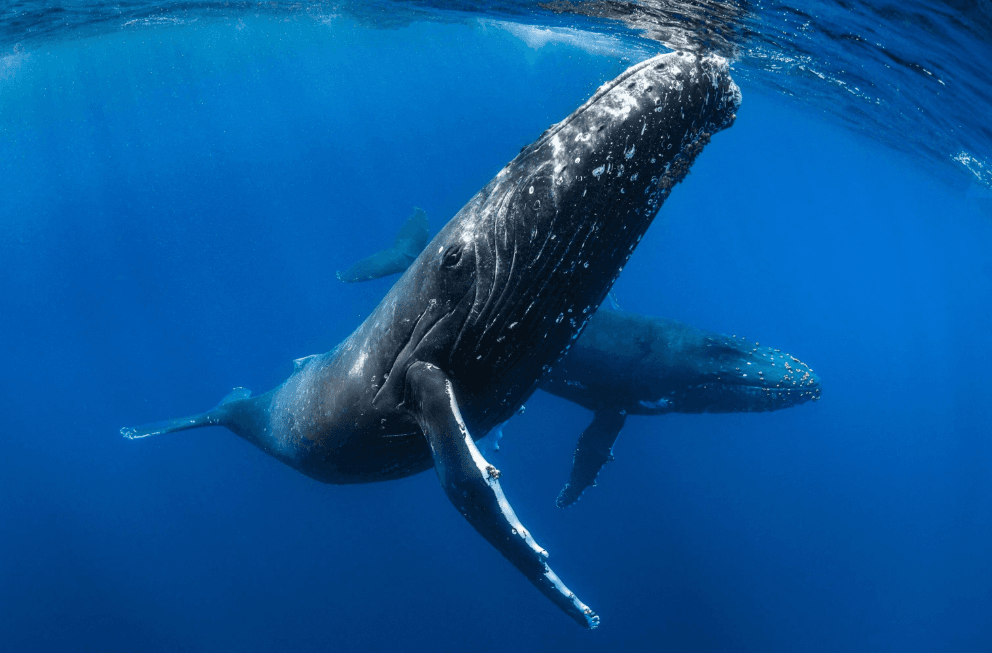
Humpback whales may engage in social encounters, including interactions involving multiple adults.
A whale's direction of travel may change during an encounter, but a short-term turn is not necessarily evidence of a seasonal route change.
Researchers need observations over sufficiently long periods to distinguish temporary behavioral responses from broader movement patterns.
4. Environmental conditions
Water currents, tides, weather, water depth, and coastal geography may influence movement opportunities or the routes researchers can observe.
Scientists can investigate these relationships by comparing environmental records with whale locations. They should not attribute a route change to a particular condition without evidence that supports the connection.
How Do Scientists Compare Routes Across the Season?
1. Collecting observations at different times
The first step is to collect whale sightings during multiple parts of the breeding season.
Researchers record the location and time of each sighting, along with information about observation effort and sea conditions. Repeated surveys help build a picture of how whale distribution and movement may change.
For meaningful comparisons, researchers should use consistent survey methods where possible. If one period receives much more observation effort than another, the resulting sighting patterns may not be directly comparable.
A useful study therefore records not only where whales were seen but also where, when, and how intensively observers searched.
2. Identifying individual whales
Photo-identification can help researchers determine whether a whale seen early in the season is the same individual observed later.
Humpback whales have distinctive tail-fluke patterns, including differences in pigmentation and markings. Researchers can compare photographs and assess the confidence of proposed matches.
When an individual is recognized across multiple encounters, scientists can examine its recorded locations over time.
For example, an identified whale photographed in one area early in the season and another area later provides evidence that the same animal visited both locations. It does not, by itself, reveal the precise route taken between those observations.
Individual identification helps separate two different possibilities:
- Different whales are using different areas at different times.
- The same whales are changing their movement patterns during the season.
That distinction is essential when investigating seasonal routes.
3. Organizing observations into seasonal periods
Researchers can divide a study period into comparable intervals, such as early, middle, and late season.
The exact dates should be selected according to the study design and available observations rather than assumed to represent universal biological stages.
For each interval, researchers can summarize:
- The number of recorded sightings.
- The locations where whales were observed.
- The number of identified individuals.
- The movement sequences documented for those individuals.
- The amount of survey effort.
- The uncertainty associated with each record.
These summaries allow researchers to compare periods while keeping differences in data quality visible.
4. Mapping movement patterns
Geographic information systems (GIS) can help researchers display sightings and movement sequences on maps.
Scientists may create separate maps for different periods and compare the patterns visually. They can also use statistical methods to test whether changes in distribution or movement are larger than would reasonably be expected from sampling variation.
Depending on the available data, analyses may examine the locations used by individual whales, the distance between observations, the direction of recorded travel, or the frequency with which certain areas are visited.
A map of sighting locations is not the same as a map of confirmed travel routes. When observations are separated by long periods, the path between them remains uncertain.
Researchers should clearly distinguish observed locations from inferred connections.
What Evidence Shows That a Route Has Actually Changed?
A convincing investigation requires more than a difference between two maps.
Scientists look for several forms of supporting evidence.
Repeated observations of the same individual: Records from identified whales can reveal whether their locations or movement sequences differ across the season.
Comparable observation effort: Similar survey coverage helps reduce the risk that apparent changes are simply caused by more intensive searching in one period.
Reliable timing and location data: Accurate timestamps and coordinates help establish the sequence of recorded movements.
Repeated patterns across individuals or years: Similar results from independent observations can provide stronger evidence than a single unusual encounter.
Consideration of alternative explanations: Researchers assess whether changes in the mix of whales present, weather, visibility, or survey methods could explain the apparent difference.
Not every study will have enough information to demonstrate a change in individual routes. In some cases, the most scientifically appropriate conclusion is that the available records show a change in observed distribution, while individual movement remains uncertain.
How Do Scientists Separate Seasonal Movement From Changes in Whale Numbers?
This is an important challenge.
Imagine that more whales are recorded in one part of the bay during a later survey period. There are several possible explanations:
- Whales already present may have moved into that area.
- New individuals may have arrived.
- Other individuals may have left nearby areas.
- Observers may have searched that area more intensively.
- Weather or visibility may have made whales easier to detect.
Each explanation suggests a different biological interpretation.
Photo-identification, repeated surveys, and information about survey effort can help researchers distinguish among these possibilities.
Statistical models may also account for imperfect detection, depending on the study design and the quality of the data.
Without these checks, a change in the number of sightings should not automatically be described as a change in the routes followed by individual whales.
Can Scientists Use Satellite Tracking to Study Seasonal Routes?
Satellite telemetry can provide detailed information about whale movements when tracking devices are appropriate, permitted, and safely deployed.
A tracking device may record positions over time, allowing researchers to examine movement sequences that would be difficult to reconstruct from occasional sightings alone.
Tracking data can help investigate:
- The direction and distance of travel.
- Changes in movement speed.
- The timing of departures from particular areas.
- Connections between regional locations.
- Differences in movement patterns among tracked individuals.
However, telemetry has limitations. Not every whale can or should be tagged, devices may stop transmitting, and tracked animals may not represent the entire population.
Tagging also requires specialized expertise, ethical review where applicable, and compliance with relevant permits and wildlife protections.
Photo-identification and systematic surveys remain valuable approaches, particularly when researchers want to study many individuals over multiple seasons without attaching devices.
Why Do Seasonal Route Comparisons Matter for Conservation?
Understanding when and where whales move can help inform decisions about marine protection and responsible human activity.
If reliable evidence shows that whales repeatedly travel through a particular area during a specific period, researchers and management authorities can evaluate whether that area deserves additional attention.
Seasonal movement studies may contribute to:
- Identifying periods when whale activity is concentrated in particular areas.
- Assessing potential interactions with commercial and recreational vessels.
- Improving the timing and design of future research surveys.
- Identifying gaps in the available movement records.
- Evaluating whether conservation measures account for changes throughout the season.
These applications require careful interpretation. A route used during one observed period may not represent every whale or every year.
Conservation planning should consider uncertainty, variation among individuals, and changes in the marine environment over time.
Common Mistakes When Interpreting Seasonal Whale Routes
Several mistakes can lead to misleading conclusions.
Mistake 1: Treating all sightings as different whales. The same individual may be photographed repeatedly.
Mistake 2: Assuming fewer sightings mean fewer whales. Detection conditions and observation effort can affect the number of recorded encounters.
Mistake 3: Connecting distant sightings with an unverified route. A line on a map does not prove the exact path an animal followed.
Mistake 4: Assuming every whale follows the same seasonal schedule. Individuals may differ in arrival, departure, and local movement.
Mistake 5: Attributing every route change to weather or boats. Researchers need evidence to establish which factors, if any, are associated with a change.
Avoiding these errors makes seasonal movement research more useful for scientists, conservation planners, and people interested in whale watching.
Frequently Asked Questions
Do humpback whales change their routes during the breeding season?
Their movements can vary, but whether individual whales change particular routes in Samaná Bay must be established through suitable observations. Changes in sightings alone do not prove that individual routes have changed.
When do scientists compare seasonal whale movements?
Researchers may compare early, middle, and late portions of a breeding season. The time periods depend on the research question, survey schedule, and available data.
How do scientists know whether the same whale returns later in the season?
Researchers can compare photographs of distinctive tail-fluke patterns and other identifying features. They assess the reliability of each match before using it to infer movement.
Can weather cause humpback whales to change routes?
Environmental conditions may influence movement, but a correlation between weather and a route change does not establish causation. Scientists need suitable environmental measurements and repeated observations.
Are seasonal whale routes identical every year?
That should not be assumed. Researchers need observations across multiple years to evaluate consistency and determine whether patterns vary among seasons or individuals.
Why is this research relevant to Samaná whale watching?
Understanding seasonal movement may improve knowledge of whale distribution and help inform responsible observation practices. It can also highlight why sightings and routes should never be treated as perfectly predictable.
Conclusion
Determining whether humpback whales use different travel routes during the breeding season requires researchers to compare observations across time, identify individual animals where possible, and account for differences in survey effort and detection.
Seasonal changes in sighting locations may reflect movement by individual whales, changes in which animals are present, or differences in observation conditions. Distinguishing between these explanations is essential for drawing reliable conclusions.
For Samaná Bay, systematic seasonal research can help build a clearer understanding of how humpback whales use the region. The strongest findings will come from repeated, well-documented observations that clearly separate measured movement from uncertain inference.

Local explorer & expert guide in Salto El Zumbador.